One core theory, N routine scenarios for ubiquitous access, and N extreme scenarios for disaster response.
Research framework · 1 + 2N
Core theory · Applications and emergency response
011 Set of Vertical Domain Application Solutions
One domain-specific application framework
A domain-specific framework for remote, dispersed connectivity and rapid disaster recovery
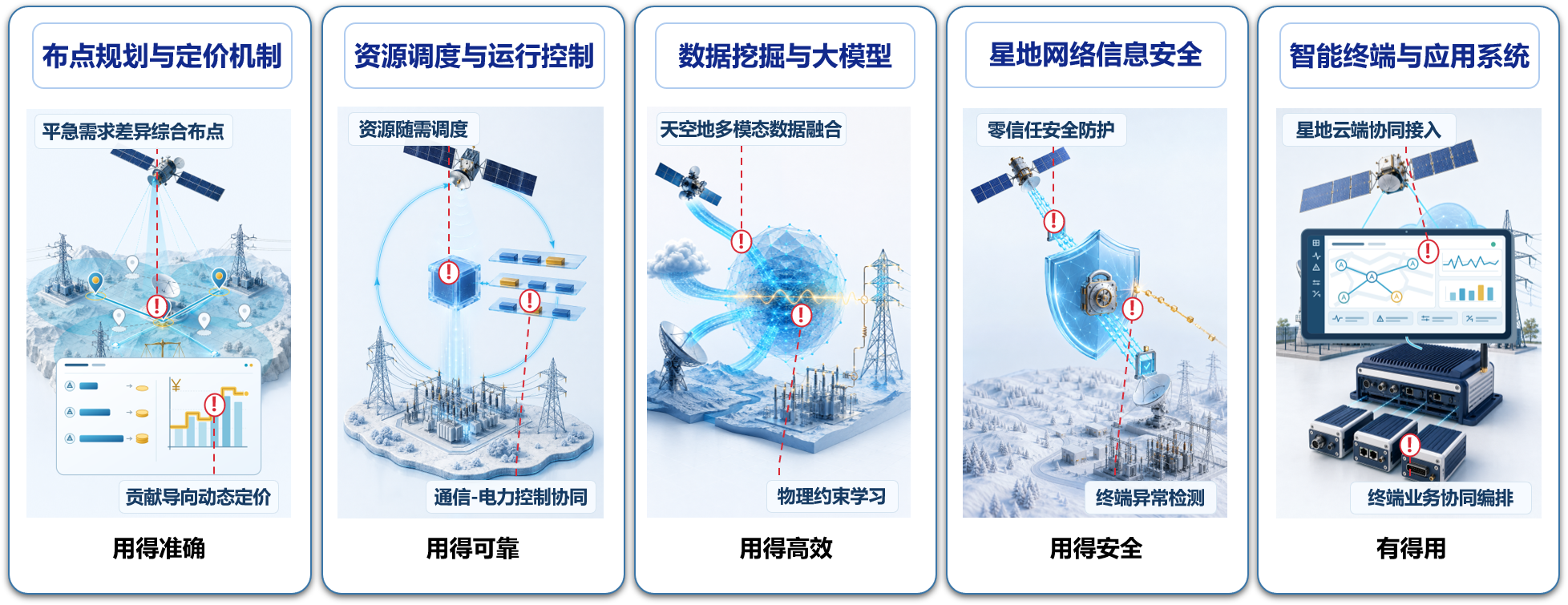
Deployment planning and pricing
We study coordinated placement of satellite terminals, UAV docks and communication resources for routine and emergency operations. For resilience resources involving multiple stakeholders, we investigate contribution assessment, dynamic pricing and benefit allocation.
Resource scheduling and operational control
We study on-demand communication resource scheduling and communication–power control coordination under time-varying satellite links and limited resources, supporting reliable critical power services in complex environments.
Data mining and large models
We study multimodal fusion, physics-constrained learning, anomaly detection and risk assessment using heterogeneous space–air–ground data, and explore large-model-driven power-system analysis, task planning and emergency decisions.
Satellite–terrestrial network security
We investigate zero-trust access, dynamic trust evaluation, network anomaly detection and attack protection for integrated power information networks with ubiquitous access.
Smart terminals and application systems
We develop satellite terminals for power applications, coordinated satellite–terrestrial–cloud access and service orchestration. Integrated terminal–link–platform test systems make data transmission visible, measurable and verifiable.
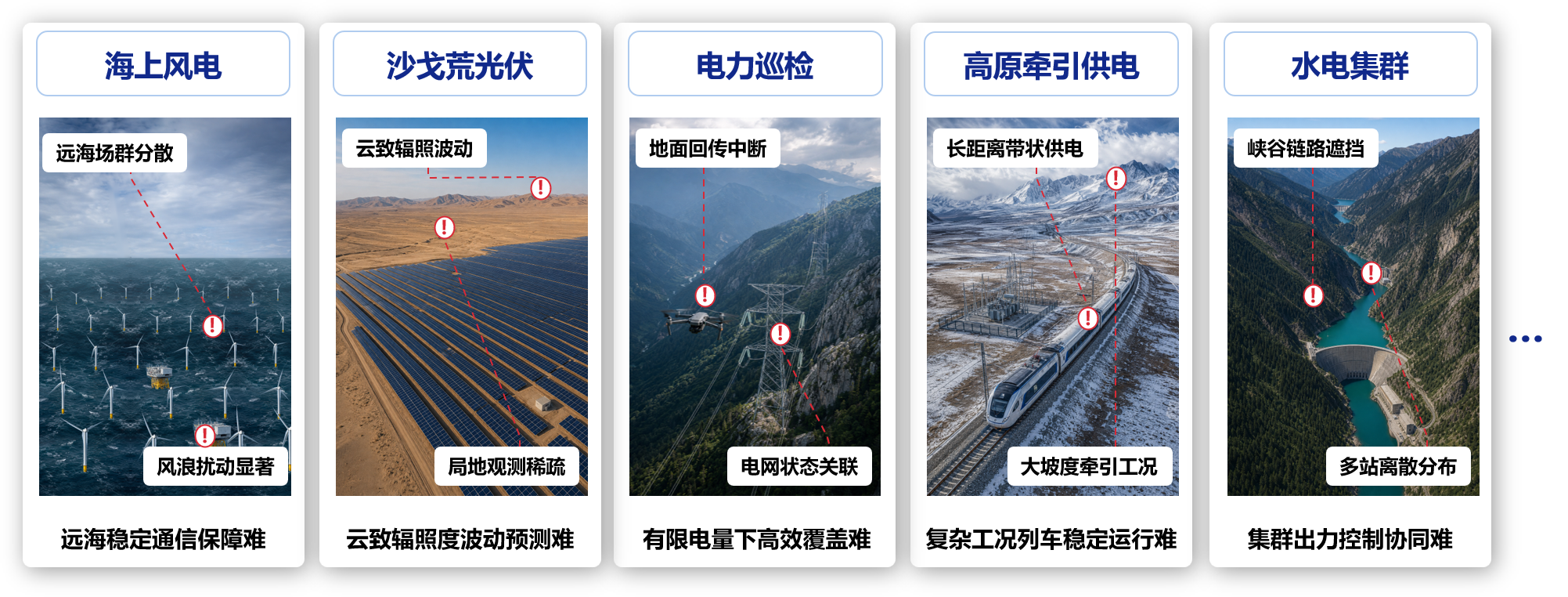
For dispersed offshore wind clusters, fluctuating communication links and concurrent services, we study satellite-assisted turbine control, coordinated risk awareness and intelligent multi-UAV inspection.
Desert and arid-region photovoltaics
For widely dispersed plants, sparse local observations and rapidly changing cloud cover, we study satellite–terrestrial observations, satellite-link environment awareness and photovoltaic power forecasting.
Power infrastructure inspection
For remote corridors with weak communications, limited UAV endurance and incomplete local observations, we study risk-aware inspection, active sensing and coordinated multi-UAV routing.
High-altitude railway traction power
For long linear power systems, rapidly changing traction loads and limited communication resources, we investigate traction-power and satellite-communication coordination and reliable delivery of critical control information.
Hydropower clusters
For canyon obstructions, dispersed plants and coordinated cluster control, we study satellite coverage extension, multi-site information coordination and hydropower cluster operation.
03N Extreme Emergency Scenarios
N extreme emergency scenarios
LEO satellite sensing supports disaster warning, prevention and coordinated power-system recovery
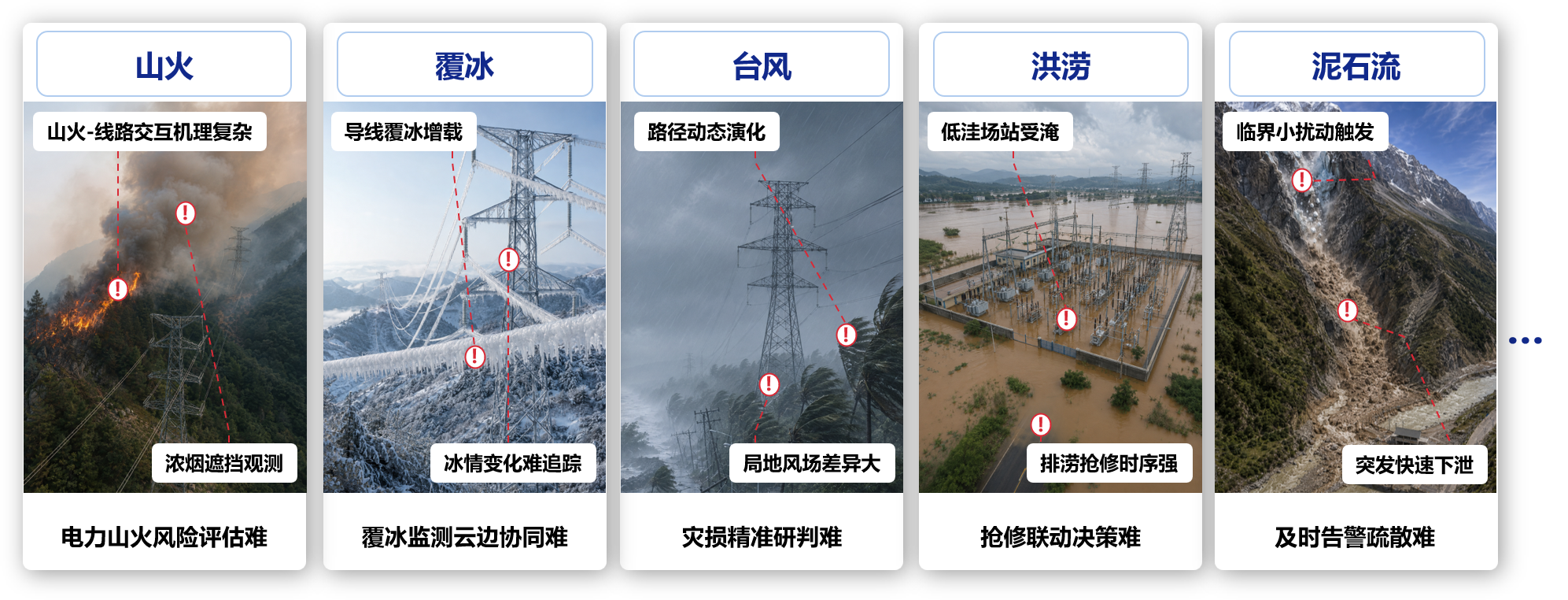
Wildfires
To address hard-to-detect small fires, complex wildfire development and uncertainty in power-line risk assessment, we study space–ground sensing, fire-spread prediction combining physics and data, power-line risk assessment, and the reconfiguration of communication networks during disasters.
Ice accretion
To address increased conductor loading from ice and the difficulty of tracking changing ice conditions, we study integrated space–air–ground monitoring, ice-condition sensing, and cloud–edge collaborative analysis.
Typhoons
To address evolving wind and rainfall hazards and the coupling between damage assessment and recovery decisions, we study pre-disaster resilience resource allocation, power-facility risk assessment, and coordinated recovery of communication and power systems.
Floods
To address inundation of low-lying facilities and the coordination of drainage and emergency repairs, we study disaster sensing, damage assessment, and coordinated dispatch of emergency resources.
Debris flows
To address sudden-onset hazards, rapid development and short warning times, we study integrated space–air–ground sensing, risk warnings, and emergency protection of power facilities.